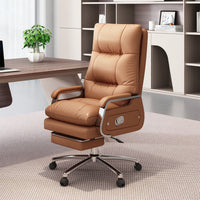

At 8:30 in the morning, the choice can seem obvious. The leather chair feels padded and substantial. The mesh chair feels lighter and cooler. Either one may seem comfortable during a five-minute trial.
By midafternoon, different details begin to matter. The mesh back may still allow air to move, but the seat frame or tension may feel more noticeable. The upholstered chair may continue to feel supportive, or its warmth and cushion depth may become distracting. Armrests that looked generous may prevent either chair from getting close enough to the keyboard.
That is why a mesh vs leather office chair decision cannot be made from upholstery alone. Material affects heat, cleaning, and the look of the chair. For all-day use, the bigger question is whether the seat, back, arms, and recline fit the user and still let the chair approach the desk. That is the comparison worth making late in the day, not just during a five-minute trial.
First, Find Out What the Product Is Actually Made Of
Two chairs can both be described as mesh and feel completely different.
One may have a mesh back with a molded foam seat. Another may suspend both the back and seat in mesh. A third may add a thin upholstered pad over part of the seat. These constructions change airflow, initial softness, pressure distribution, and the way the front or side frame feels against the user.
"Leather office chair" is also a broad description. A listing may refer to top-grain leather, another natural leather specification, microfiber leather, PU leather, or a combination used on different parts of the chair. The seat, back, outer panels, and armrests are not necessarily covered in the same material.
Before comparing prices, confirm three things:
- the material on the seat and back, including whether the side and rear panels differ;
- whether the seat uses suspended mesh, molded foam, layered foam, or another construction;
- the care instructions for the exact color and material option in the cart.
Keep the selected SKU or option with the product drawing. A material description copied from a different variant may not apply to the chair that will actually arrive.
The 8:30 Test: Initial Softness Can Be Misleading
A padded leather chair often makes a strong first impression because the upholstery and foam yield when the user sits down. That can feel pleasant in a private office used for conversations, reading, and computer work. It says little, however, about whether the seat is the right depth for a long session.
Sit fully against the backrest rather than perching on the front edge. The thighs should be supported without the front of the seat pressing into the backs of the knees. The user should be able to place the feet on the floor or a suitable foot support while keeping a workable relationship to the desk.
A mesh seat gives a different first impression. It may feel firmer or more responsive because the user is supported by tension rather than a thick cushion. Check whether the tension feels even and whether the seat frame is noticeable at the front or sides. A wider-looking chair is not necessarily more usable if the firm perimeter reduces the comfortable sitting area.
Before judging softness, find where the backrest meets the lower back. A plush seat will not fix poor lumbar contact, and a breathable back will not make an overly deep seat easier to use.
Noon: Airflow Matters, but Only Where the Mesh Exists
Mesh allows air to pass through the part of the chair where it is used. That is a practical advantage in a warm office, beside heat-producing equipment, or for someone who spends long periods at the workstation.
But a mesh back with a foam seat is not the same as a full-mesh chair. It may keep the user's back cooler while the seat behaves more like a conventional upholstered cushion. That hybrid can be a useful compromise for someone who wants backrest airflow without an all-mesh seat, but the product description should make the construction clear.
Leather and leather-like upholstery create a more continuous surface. Warmth varies with the exact material, room temperature, clothing, direct sun, cushion construction, and sitting time. A chair tested in a cool showroom may feel different beside an office window in the afternoon.
If the chair will sit near a sunny window, test that position during the brightest part of the day. Heat and glare may change the experience even in an air-conditioned room. Check the upholstery care guidance before planning placement or applying a cleaner or conditioner.
To see the two formats in practice, compare Anzhap's Classic Office Chair with Breathable Mesh with the upholstered 22-inch Leather Office Chair with Recline and Armrests. Check the seat construction and selected options on each product page; the backrest material does not tell the whole story.
At 3:30, the Adjustment Range Matters More Than the Material Label
Late-day discomfort is often blamed on upholstery because that is the most visible difference between two chairs. The real cause may be a seat that is too high, a backrest that does not meet the lumbar area, armrests that hold the shoulders up, or a desk that forces the user to reach forward.
When comparing an office chair for long hours, make four checks before weighing optional comfort features:
- Set the seat height, then confirm the feet are supported and the keyboard can be reached without lifting the shoulders.
- Sit against the backrest and check seat depth and lumbar contact together.
- Adjust the armrests, then roll up to the desk to see whether they clear the work surface.
- Recline and return while typing or reading rather than testing the mechanism in isolation.
Run the same checks on both chairs. If only one lets the user reach the keyboard without leaning, that result is more useful than the upholstery label.
The same principle applies to shared seating. A chair used by several employees needs controls that are easy to find, enough adjustment range for the intended users, and a setup that can be restored quickly. A premium material does not make a fixed or confusing chair more adaptable.
The End-of-Day Test: Cleaning Is Part of the Buying Decision
The easiest chair to clean is the one whose material and construction match the actual messes in the room.
Mesh openings can collect dust, lint, and crumbs that are less visible on a solid surface but take more effort to remove from the weave. Seams, adjustment housings, and the gap between the seat and back can also trap debris. Ask whether gentle vacuuming or brushing is permitted for the selected mesh and avoid pulling at a snag.
A leather or leather-like surface may be easier to wipe after a small spill, but cleaning products are not interchangeable. A product suitable for one natural or synthetic upholstery can discolor, dry, or leave residue on another. Obtain the care instructions for the exact material and test any approved product in an inconspicuous area.
For a clinic, reception desk, training room, or hoteling station, also ask who cleans the chair and how often. If the maintenance routine requires a product or method the facilities team does not use, the material advantage may disappear in practice.
Appearance Has a Job Too
A leather executive chair can give a private office more visual weight and can coordinate with an executive desk, wood storage, or a client-facing meeting area. A tall padded back may also suit work that moves between computer use, calls, document review, and informal conversation. The tradeoff is a larger visual and physical presence that should be checked against the desk, wall, and storage behind the user.
A mesh office chair usually has a lighter outline. In rows of workstations, the open back can keep repeated chairs from appearing as a continuous upholstered wall. Mesh models may also offer lumbar support, headrests, adjustable height, swivel movement, or recline, depending on the selected design.
Neither material owns the professional look. An office usually feels more deliberate when the chair scale, color, and condition suit the room than when every chair is chosen to match an executive or ergonomic label.
Choose for the Room and the Person, Not for the Product Photo
A Full-Day Workstation in a Warm Office
Start with a mesh back or another breathable construction, then check the seat separately. Prioritize usable seat depth, lumbar placement, adjustable arms, and a base that moves easily on the actual floor. A mesh-back chair with a supportive upholstered seat may be more suitable for some users than a full-mesh seat.
A Private Office That Regularly Receives Clients
A leather executive chair can support the intended visual tone and provide a more upholstered sitting experience. Confirm the exact leather or synthetic material, normal-room temperature, cushion fit, desk approach, and recline space. Do not accept a larger chair merely because it looks more substantial behind the desk.
Shared Desks and Conference Rooms
Easy adjustment, understandable controls, chair width, arm clearance, and cleaning instructions may matter more than the upholstery category. Test several chairs together at the table or workstation. A model that works alone can still create collisions when neighboring users pull back or swivel at the same time.
For the spatial test, use Anzhap's office chair clearance and desk-fit guide to check armrest height, caster-base width, rollback, swivel, and recline before choosing the material.
Run a Fair Side-by-Side Test
A fair comparison does not require an entire workday. Give each chair 20 to 30 minutes at the same desk, in normal work clothing, and adjust it from scratch. Type, use the mouse, lean back to read, turn toward nearby storage, and stand up again.
Record specific observations:
- Where do the seat and back make contact after 20 to 30 minutes?
- Does the user notice warmth, a hard frame edge, a deep cushion, or pressure behind the knees?
- Can the chair reach the desk at the correct height, and are the controls easy to use while seated?
- Can the material be maintained with the office's normal cleaning routine?
For a larger order, let representative employees test the finalists. Record their body dimensions and work type with the feedback instead of collecting only a general comfort score. One chair may suit a range of users; no material guarantees a universal fit.
What to Confirm Before Ordering Online
Product photos show shape and finish, but they cannot reproduce seat tension, foam response, room temperature, or the user's proportions. Before checkout, verify:
- the upholstery on the seat, back, sides, and armrests for the exact SKU and color;
- seat height, usable seat width and depth, plus overall width and reclined depth;
- lumbar, armrest, headrest, and recline adjustments included with the selected option;
- care instructions, applicable warranty terms, and available replacement parts.
With those details in hand, browse Anzhap's office chair collection according to the work and room the chair needs to support.
Frequently Asked Questions
Is a Mesh Office Chair Better for Long Hours?
Mesh can improve airflow through the areas where it is used, especially in a warm room. It is not automatically better for long hours; seat depth, tension, lumbar contact, and desk fit still need to work for the user.
Does a Leather Office Chair Always Get Hot?
Not always. Warmth depends on the upholstery, cushion, clothing, room temperature, sun exposure, and sitting time. Test the intended location rather than relying on the material name alone.
Which Lasts Longer, Mesh or Leather?
There is no useful answer without the exact specifications. Mesh tension, upholstery grade, seams, foam, frame construction, user load, cleaning, and environment all affect service life. Compare the warranties and care instructions for the two actual models.
Is Mesh Harder to Clean Than Leather?
Mesh can hold dust and debris in the weave, while a solid surface may be quicker to wipe. Leather and leather-like materials still require compatible cleaning products, so follow the instructions for the selected upholstery.
Which Office Chair Looks More Professional?
Leather often looks more traditional and substantial; mesh usually looks lighter. Either can work in a professional office if its scale, color, and condition suit the room.
Should One Office Use the Same Chair Material Everywhere?
Not necessarily. Workstations, private offices, conference rooms, and shared desks can have different needs. A consistent color palette can tie the office together without forcing the same chair construction into every room.
Make the Choice at the End of the Day
Choose the chair that survives the less flattering test: late afternoon, normal room temperature, an actual keyboard, and the office's real cleaning routine. If one chair still fits the user and reaches the desk while the other does not, that answer is more useful than declaring mesh or leather the universal winner.